Pot over seven, plus panic
Mostly ignores the score gap unless it's the final round (F=1) — then it panics and adds a big correction. Reacts to opponents banking, but only a little.
How we figured out the smartest way to play
Every round the pot grows, and every round a 7 can wipe it out. This page walks through how good you could be, what three different AIs guessed, and the formula that actually wins — all backed by real simulated games, not vibes.
Before judging any strategy, you need a ceiling to measure against and a floor to beat.
1.a — The ceiling
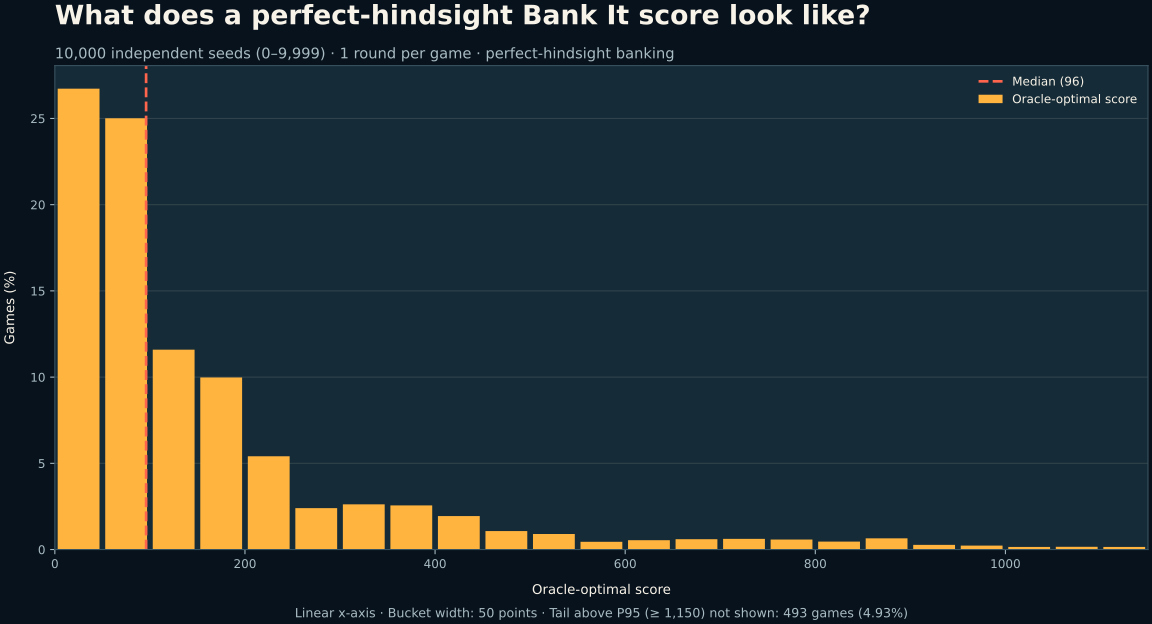
The oracle is a cheat: it's told the exact sequence of rolls in advance and always banks at the single best moment in the round. No real strategy can ever beat it — it's the mathematical ceiling. But look at the spread below: even with perfect foresight, scores swing wildly, because the doubles-double-the-pot rule occasionally hands out a jackpot round. That huge tail is the whole reason this game is interesting.
[placeholder] "Write a Python script that simulates the Bank It oracle: for a single round, try every possible banking moment against the actual roll sequence and keep the best score. Plot the resulting score distribution across N games."
Placeholder — real prompt to be supplied.
plot_oracle_scores.py --linear --rounds 1 --games 10000 --cutoff 0.95.1.b — The floor
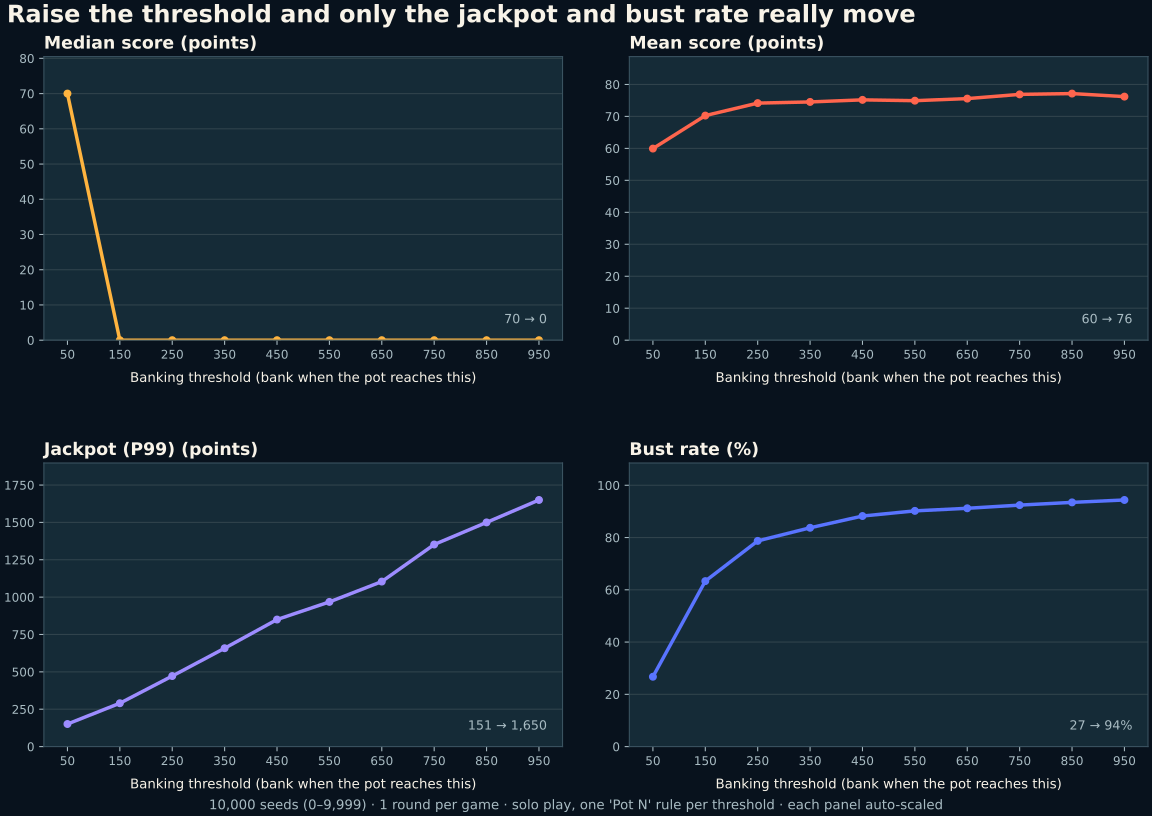
The simplest strategy anyone could invent: choose a threshold — say, 150 — and bank the instant the pot reaches it, no matter what else is happening. Sweep that threshold from small to large and plot the average score you end up with. Too low, and you're leaving points on the table every round. Too high, and a 7 crashes you before you ever cash in. The curve bends — there's a best answer, and it already gets a player most of the way to good play.
[placeholder] "Write a Python script that sweeps a fixed banking threshold from 25 to 400, plays thousands of solo games at each threshold, and plots average/median score vs. threshold value."
Placeholder — real prompt to be supplied.
plot_strategy_scores.py --threshold-sweep, data in docs/design/artifacts/fixed-threshold-sweep.csv.No simulator access, no iteration — just the rules and a request for a formula.
[placeholder] "Here are the full rules of Bank It. Derive a single formula for the optimal banking threshold as a function of the pot, score gap, rounds remaining, and number of players. Show your reasoning and the final decision rule."
Placeholder — real prompt (given verbatim to GPT-3.5, GPT-4o, and GPT-5) to be supplied.
Mostly ignores the score gap unless it's the final round (F=1) — then it panics and adds a big correction. Reacts to opponents banking, but only a little.
Balances the score gap against rounds remaining more consistently than GPT-3.5, but still misses some of the player-count pressure that matters at bigger tables.
Reasons about protecting a lead vs. chasing a deficit, and factors in how many players are at the table — the two ingredients that matter most, per Section 3.
The formulas are transcribed verbatim in solutions/40.md, solutions/gpt35.md, and solutions/gpt5.md. What separates the better ones isn't cleverness for its own sake — it's which inputs they actually use. Ignoring the score gap or the number of players costs real win rate, as the next section shows.
One formula turns your lead, the round, and the number of opponents into a single banking target.
[placeholder] "Search over families of banking-threshold formulas (score-gap-aware, round-aware, player-count-aware) and find the one that maximizes win rate across balanced tournament and 1v1 matrix simulations against every other strategy."
Placeholder — real prompt to be supplied.
Try your game state
Move the controls. The recommendation updates instantly using the same State Delta equation as the Python simulator.
Recommended target
You are 500 points behind with six rounds left. The four-player pressure factor raises your target above the standard trailing baseline.
From equation to table
Each example follows the recommendation through actual rolls. Doubles after roll three double the pot; a seven would crash every player who has not banked.
A fixed 200 player would stop too early. The deficit justifies surviving for multiplier upside.
The formula accepts fewer points because preserving a 200-point cushion is worth more than chasing another double.
Banking 400 would guarantee defeat. In the final round, the formula refuses any target that cannot take the lead.
How do we know it's actually the best?
A formula is just a guess until it's been thrown into thousands of simulated games against everything else.
Sit State Delta at a table with three random opponents, thousands of times over, and count how often it comes out on top. One row per strategy, ranked by win rate.
Put State Delta in a 1-on-1 duel against every other strategy, one at a time, thousands of games each. This isolates head-to-head dominance from any 3rd or 4th opponent's noise.
A strategy can win the tournament — a strong generalist in a crowd — while still losing a few individual matrix duels, or vice versa. They're different games, so they aren't guaranteed to agree. In the latest run they do: State Delta and Adaptive 150/200/300 lead both measures.
| Policy | 2 players | 4 players | 6 players |
|---|---|---|---|
| Fixed Pot 200 | 54.66% | 30.82% | 19.24% |
| Adaptive 150 / 200 / 300 | 65.28% | 48.63% | 40.56% |
| State Delta formula | 63.56% | 49.08% | 40.41% |